Overlooking the Real Economic Challenges of Rollups? Where is the Gap?
June 9, 2025
|
Sankalp Sharma
share


share
If you’ve landed on this page, this means either you are building a rollup or already managing one. If yes, you must know that eliminating the economic challenges of rollups while managing end-to-end infrastructure costs is one of the biggest milestones for L2/L3 rollups to achieve. Let’s understand this better with respect to fresh data.
In 2024, Ethereum generated a staggering $1.9B in revenue, despite ongoing criticisms around scalability and cost. Surprisingly, even the most prominent rollups like Arbitrum and zkSync earned only $44.1M and $24.7M, respectively—a fraction of Ethereum’s total. Such stats reveal a critical insight: there’s still massive untapped revenue potential at the Layer-2 level.
That’s where Cero comes up with a strategic solution. Designed from the ground up for economic performance, Cero unlocks new revenue opportunities that can be revealed through advanced sequencer economics, modular data availability, and proof infrastructure optimized for profitability. It’s not just about scaling—it’s about scaling while maintaining economic viability.

Like every other business model, Layer2/Layer3 rollups also seek to maintain economic viability over time and achieve sustainability. But, there can be several cost factors that can interrupt their economic vision. And as a result, these rollups might have to incur unmanageable costs or rely heavily on external funding. Seeking a solution, rollups have started searching for novel ways. Can a rollup be profitable or cost-effective enough to survive and grow long-term?
These are the key expenses requirements in a standard L2/L3 rollup setup. Again, cost might increase or go down as per the specific design/setup. costs outweigh the revenue from user fees or ecosystem incentives, the rollup becomes economically non-viable.
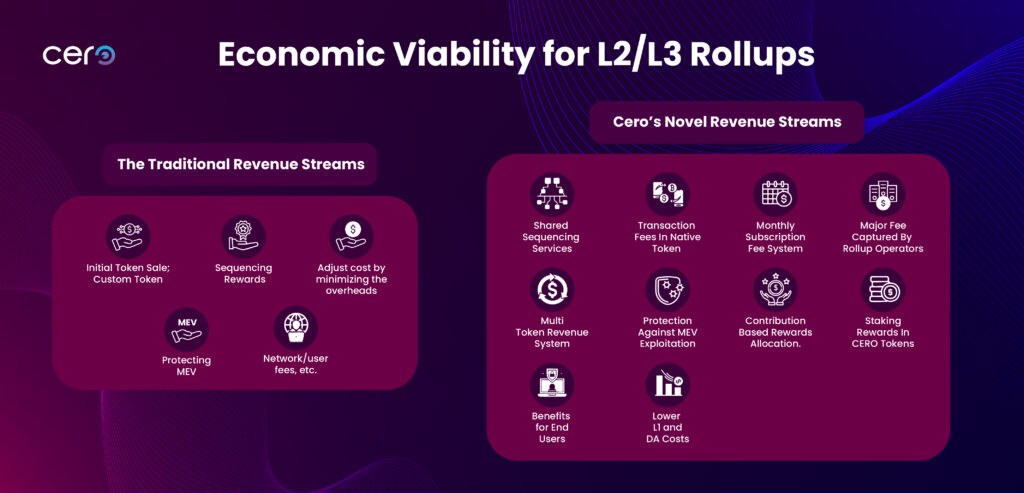
Cero offers a novel and innovation-driven economic model that eliminates the economic challenges of rollups existing traditionally. For a better understanding, let’s first learn the traditional ways and then detailed revenue methods offered by Cero:
The traditional revenue streams:
Learn a detailed description of traditional rollups’ revenue from here.
Cero Decentralized Sequencer offers a variety of services to maximize revenue in rollups, thereby ensuring zero economic challenges.. Here’s the specific information:
1. Shared sequencing services-
Rollups right now struggle with the limitations of a centralized sequencer, where Layer2 rollups can only serve as a sequencer to other projects building on top of it, with no benefit for their own ecosystem. Now with Cero’s offerings, rollups & appchains from several other ecosystems participate in a shared sequencing network called Super-system. Under this ecosystem, each rollup can provide security to multiple other rollups in the ecosystem. Likewise, other rollups can also provide security to your rollups. This encourages decentralization and ensures there’s no value leakage within the ecosystem.
2. Transaction fees in Native token-
Cero shared sequencer enables the rollups to accept the transaction fee in the network’s native token. This removes the obligation for users to maintain a certain token balance in some additional token. Because of this, the value for native tokens increases, which in turn generates more revenue.
3. Monthly subscription fee system-
Instead of paying a bulk, one-time payment, rollups have the ease of opting for Cero’s monthly services through a monthly subscription fee system to be paid in Cero’s native token. This fee is again routed to the network’s validators (a combination of rollups and external participants). Hence, this circulation stabilizes the circulation of tokens within Cero’s Super-system.
4. Major fee captured by Rollup operators-
No matter who actually processes the transactions (inside the shared participation), most of the transaction fees still go to the rollup operator. Only a small portion is shared with other validators or sequencers. As a result, validators can earn rewards in different kinds of tokens. Since subscription fees are paid in CERO tokens, Rollup operators get income from various sources, reducing their reliance on a single token’s value.
5. Multi-token revenue system-
The amount of different tokens a rollup operator earns depends on how much they contribute to the overall fee pool of the larger system. Validators who don’t contribute to this pool — including outside validators — won’t receive extra rewards in Rollup tokens.
6. Protection against MEV exploitation-
While MEV is essential in rollups to extract monetary value from the entities performing transactions on the blockchain, we can’t overlook its double-edged nature. These same entities can exploit the MEV and increase the transaction cost. With Cero, L2/L3 rollups can implement proven strategies like Arbitrage and Liquidation to maintain good MEV and ultimately cut down the expenses.
7. Contribution-based Rewards allocation-
Validators also earn CERO tokens as block rewards for helping with transaction processing. The amount they earn depends on how much they’ve staked. This gives Rollup operators another source of income and again reduces reliance on just one token.
8. Staking Rewards in CERO Tokens-
Validators receive CERO tokens as block rewards for helping to process transactions. The more they stake, the more they earn. This gives Rollup operators another way to earn revenue while diversifying away from one token.
9. Lower L1 and DA Costs-
Because rollups group many transactions together and include external validators within Cero’s shared sequencer environment, the costs for Layer 1 (L1) and Data Availability (DA) operations are again reduced.
Now that we’re wrapping up, here’s the conclusion: ‘Economic viability is not optional, it’s integral for rollups’. This refers to the difference between launching a successful rollup and a short-lived experiment. For rollup builders, zero economic challenges means:
So, don’t leave behind, explore additional revenue that Cero brings. You’re building a rollup and not thinking about this—you’re already behind. Request your Early Access or explore the Lotus Testnet.